
 English
 Français
 Deutsch
 Svenska
 Español



Twee jaar geleden betekende een serverzaal rijen warme servers die werden gekoeld door koude lucht onder een verhoogde vloer. Ingenieurs regelden elke koelkast één keer in en lieten hem verder met rust. De gedeelde koudwaterleiding had ruimte over — kleine debietverschillen tussen kasten verdwenen in de thermische marge. De warmtedichtheid was bescheiden, misschien vijf tot tien kilowatt per rack in het hoogste segment. De kring was vergevingsgezind.
Vandaag betekent een serverzaal rijen vloeistofgekoelde kasten, waarbij elke kast zijn eigen thermische microklimaat vormt. De omslag verliep niet geleidelijk.
Dit artikel gaat over wat er met de koelkring gebeurt wanneer één kast meer warmte opneemt dan een hele rij voorheen — en over het onopvallende onderdeel dat bepaalt of de kring de verandering overleeft. Een doorstroombegrenzer op kastniveau is precies dat onderdeel.
De koelkring die placht te vergeven
Een traditionele datacenter-koelkring is een gedeeld systeem. Eén koudwaterhoofdleiding voedt een verdeler; de verdeler distribueert naar meerdere koelkasten in aangrenzende rijen. Elke kast trekt zijn ontwerpdebiet uit de verdeler en stuurt opgewarmd water terug naar een retourleiding. De koelmachine neemt de warmte uit het retourwater op. Een koeltoren staat die af aan de atmosfeer.
Deze architectuur werkte omdat de ontwerpcondities stabiel waren. Luchtgekoelde racks van vijf tot tien kilowatt konden worden gekoeld met koude lucht op kamertemperatuur. De warmte veranderde langzaam over een dag. Als één kast vijf procent meer debiet trok dan een andere, compenseerde de andere stil. De thermische marge was breed genoeg dat een ingenieur het systeem één keer bij ingebruikname inregelde en dat het systeem zijn ingeregelde toestand jarenlang vasthield.
Elke ingenieur met ervaring in hydraulische inregeling herkent deze kring. Het is dezelfde architectuur met gedeelde verdeler die koudwater distribueert in commerciële klimaatinstallaties, die parallelle takken voedt in stadskoeling, die proceswater levert aan meerdere afnemers in een industriële plant. De vergevingsgezindheid maakte het tot de standaardarchitectuur.
Wat AI met de kring deed
De komst van dichte GPU-clusters veranderde de warmtedichtheid per rack met een orde van grootte. NVIDIA H100-racks dreven de kastbelasting op tot vijftig kilowatt en hoger. Blackwell-racks voor AI-training overschrijden de honderd kilowatt en blijven stijgen. De koelkast, ooit een passieve thermische knoop, werd een actief thermisch regelsysteem — een coolant distribution unit (CDU) die nauwkeurig, modulerend debiet op afroep trekt.
Vloeistofkoeling, tot voor kort exotisch, werd standaard. De markt voor vloeistofkoeling benaderde in 2025 drie miljard dollar en zal naar verwachting zeven miljard dollar benaderen tegen 2029 naarmate AI-implementaties versnellen. Vertiv, Panasonic en Schneider Electric lanceerden allemaal nieuwe CDU-productfamilies gericht op AI-werklasten met hoge dichtheid in de eerste helft van 2026. De hardware liep mee. De architectuur van de koelkring, op veel sites, niet.
Waarom gedeelde hoofdleidingen het begeven
Het mechanische probleem is rechtlijnig. Wanneer één kast opschaalt — een trainingsrun start op een GPU-cluster — trekt zijn CDU meer water uit de gedeelde verdeler. De druk over de verdeler valt weg. De naburige kasten, zonder enige fout in hun ontwerp of inregeling, ondercirculeren stil. Hun CDU’s zien minder koelvloeistof dan ze nodig hebben, sturen het retourwater warmer terug dan voorzien en zien hun interne thermische marges instorten.
Sommige CDU’s compenseren door hun eigen pompen op te voeren. Andere niet. Hoe dan ook, de verdeler wordt een slagveld: elke kast vecht om een eindige toevoerdruk. De toevoertemperatuur loopt op. De koelmachine moet harder werken om bij te trekken. De koeltoren, de laatste schakel in de warmteafvoerketen, verhoogt zijn spuitfractie. Meer water verlaat het systeem als blowdown. Meer energie wordt besteed aan vervanging.
Op campusniveau is de kost meetbaar. Datacenters in de Verenigde Staten kunnen tegen 2030 tussen 697 miljoen en 1,45 miljard gallon extra waterbehoefte per dag vereisen — de bovengrens benadert de dagelijkse stedelijke watervoorziening van New York City. Niet alle vraag is vermijdbaar. Een betekenisvolle fractie komt echter voort uit systemen die buiten hun ontwerpenvelop draaien omdat de architectuur het debiet per kast onder variabele last niet stabiel kan houden.
Drukafhankelijk debiet — de stille faalmodus
Een CDU die water trekt uit een gedeelde verdeler is drukafhankelijk van zijn buren. Wanneer hun debiet verandert, verandert ook zijn debiet — of de ontwerper dat nu wilde of niet. De ingebouwde regelloop van de CDU ziet de drukverschuiving in de verdeler niet; hij ziet alleen de debietverandering stroomafwaarts van zijn eigen pomp. Tegen de tijd dat de CDU bijregelt, is de stroomopwaartse conditie alweer verschoven. De regelloop jaagt op een stroomopwaartse variabele die hij niet rechtstreeks kan waarnemen.
Dit is wat wij Drukafhankelijk Debiet noemen — een veldconditie, geen leerboekcategorie. Het is de standaardtoestand van elk gedeeld koelsysteem zonder debietregeling op kastniveau. In klassieke klimaatinstallaties uitte drukafhankelijk debiet zich in inregeldrift, in terugkerende klachten over zaaltemperatuur en in service-bezoeken die hydraulische inregeling zijn slechte reputatie hebben gegeven. In AI-datacenterkoeling — waar thermische marges dunner zijn en lastveranderingen abrupter — uit het zich in versnelde slijtage van apparatuur, in intermitterende thermische uitschakelingen en in waterverspilling die lineair schaalt met de sitecapaciteit.
De oplossing is niet grotere pompen. Grotere pompen verschuiven het probleem naar een ander werkpunt op de kromme; ze breken de koppeling tussen kasten niet. De oplossing bestaat erin elke kast hydraulisch onafhankelijk te maken van alle andere. Ontkoppel de kast van de verdeler, en elke CDU draait alsof hij alleen in de kring zit.
De Overpompingskosten
Het tweede-orde gevolg van drukkoppeling is wat wij De Overpompingskosten noemen. Kasten die overpompen om drukvariaties te compenseren, sturen meer water door hun warmtewisselaars dan de thermische last vereist. Het waterzijdige ΔT over de kast valt in elkaar. De koelmachine, ontworpen voor een bepaalde retourtemperatuur, ziet kouder retourwater en draait met lager rendement. De koeltoren spuwt meer water per afgevoerde kilowatt dan de ontwerpberekeningen veronderstelden.
Vermenigvuldig met vijftig kasten per rij, tien rijen per zaal, acht zalen per campus. De Overpompingskosten worden het dominante mechanisme van waterverlies op een AI-site met hoge dichtheid — en ze zijn onzichtbaar op de energierekening totdat iemand een massabalans over de koeltoren maakt. Tegen die tijd betaalt de campus er al maanden voor.
Ontkoppelen op kastniveau
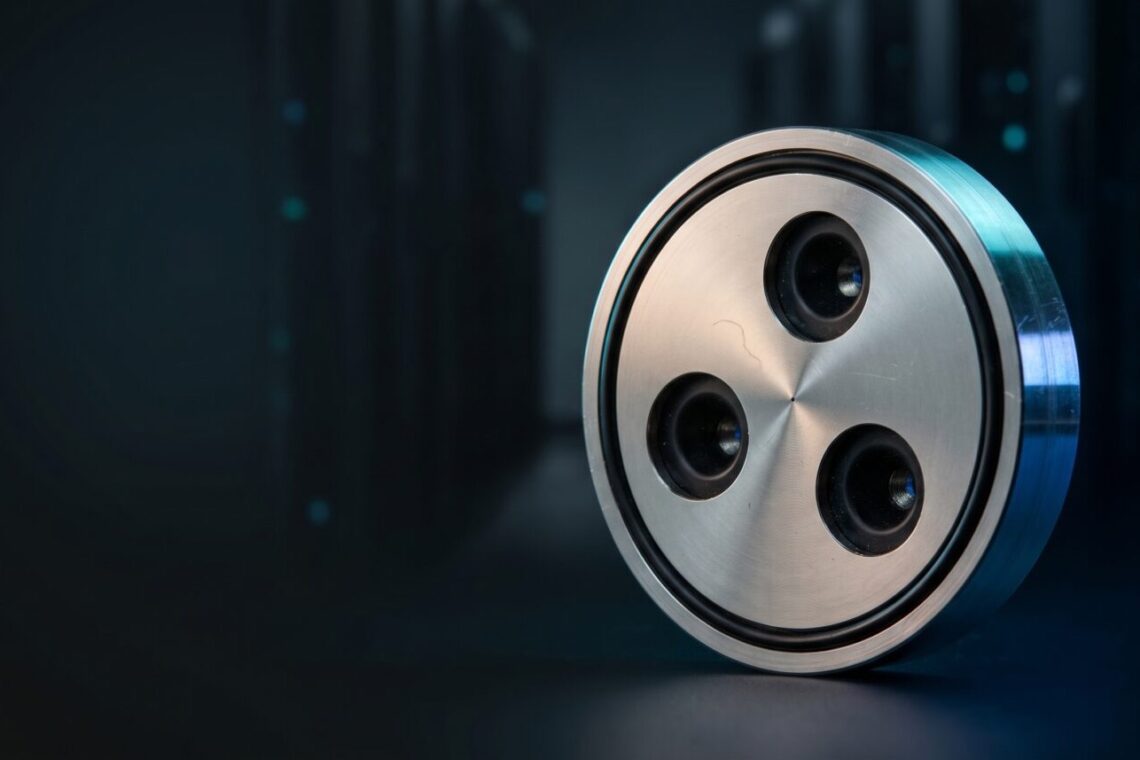
Een passieve doorstroombegrenzer — een BT-Maric doorstroombegrenzer, in de lokale terminologie — wordt direct in de kastleiding vóór de CDU geïnstalleerd. Hij houdt het kastdebiet constant ongeacht wat er bij de verdeler gebeurt. De doorstroombegrenzer is mechanisch: bij toenemende druk wordt een flexibele rubberen O-ring in een conische zitting gedrukt, waardoor de doorstroomopening verkleint en het vooraf ingestelde nominale debiet behouden blijft. Bij afnemende druk vergroot de opening overeenkomstig. Geen elektronica. Geen PID-afstelling. Geen inregelstap.
De gevolgen zijn operationeel, niet alleen thermisch:
- Elke kast draait binnen zijn ontwerp-thermische envelop, ongeacht de last van naburige kasten.
- Drukvariaties in de verdeler worden door de begrenzer geabsorbeerd, niet door de regelloop van de CDU.
- De spui van de koeltoren keert terug naar de ontwerpwaarde.
- Het ΔT over elke kast keert terug naar de ontwerpspecificatie, en het rendement van de koelmachine keert terug naar zijn nominale curve.
De thermische envelop van de kast wordt bepaald door de ASHRAE TC 9.9-richtlijnen voor dataverwerkingsomgevingen — het referentiedocument voor toevoer-, retour- en benaderingstemperaturen op kastniveau. Een correct gedimensioneerde doorstroombegrenzer op kastniveau is de eenvoudigste mechanische garantie dat die richtlijnen onder variabele last ook werkelijk worden gehaald, en niet alleen bij ingebruikname.
Het praktijkbewijs
De Bertfelt-casestudie Waterdebiet regelen in een koelsysteem beschrijft BT-Maric doorstroombegrenzers van het type Inzetstukken, direct geïnstalleerd in het leidingwerk van koelkasten. Een fabrieks-vooraf-ingesteld debiet blijft stabiel ongeacht stroomopwaartse drukvariatie, en beschermt zowel de gevoelige elektronica in de kast als de koelmachine stroomafwaarts. De casestudie documenteert de standaardtoepassing. Dit artikel legt uit waarom die standaardtoepassing nu relevant is voor elke kast op elk campus — niet alleen voor de kasten die een oplettende ingenieur specifiek had voorzien.
Veelgestelde vragen over debietregeling in datacenters
Hoe wordt een doorstroombegrenzer gedimensioneerd voor een specifieke thermische kastbelasting?
De doorstroombegrenzer wordt gedimensioneerd op basis van het ontwerp-koelvloeistofdebiet, dat op zijn beurt wordt afgeleid uit de thermische kastbelasting (kW) en het ontwerp-waterzijdige ΔT. Een kast van 50 kW met een ontwerp-ΔT van 5 °C vraagt ongeveer 143 l/min koelvloeistof; de doorstroombegrenzer wordt op dat debiet gespecificeerd. Hij houdt het over het hele werkdrukbereik, ongeacht stroomopwaartse variatie.
Waar in het kastleidingwerk moet de begrenzer worden geïnstalleerd?
Stroomopwaarts van de CDU, aan de toevoerzijde van de kast, na elke afsluiter en vóór elke filtratie in de kast. Doel is de regelaar tussen de variabele stroomopwaartse conditie (de verdeler) en de geregelde stroomafwaartse conditie (de CDU) te plaatsen. De inzetstuk-uitvoering is ontworpen voor installatie in het bestaande kastleidingwerk zonder dat de kastbehuizing hoeft te worden aangepast.
Kan de doorstroombegrenzer worden ingebouwd in bestaande zalen, of alleen gespecificeerd bij nieuwbouw?
Inbouw in bestaande installaties is het meest voorkomende patroon. De inzetstuk-uitvoering past in bestaand leidingwerk met een flens-tot-flens-afmeting die past op standaard inlaataansluitingen. Inbouwcampagnes lopen meestal kast voor kast tijdens geplande onderhoudsperiodes, zonder de zaalwerking te onderbreken.
Welk drukverschil is nodig om de regelaar in zijn werkbereik te brengen?
Een minimaal drukverschil van ongeveer 1,4 bar over de begrenzer is nodig om de rubberen O-ring in zijn regelpositie te laten vervormen bij standaard Precision-rubber. Daaronder laat de begrenzer het debiet doorstromen zonder te regelen — het mechanisme is gepauzeerd, niet gefaald. Het maximale drukverschil op standaardrubber is 10 bar. Voor hogedruk-koelkringen of sites met extreme pompkrommen breiden alternatieve rubbersamenstellingen het bereik uit tot 20 bar.
Is de begrenzer compatibel met de water-glycolmengsels die in vloeistofkoeling worden gebruikt?
Ja, mits de juiste rubbersamenstelling wordt gekozen. Het standaard Precision-rubber is compatibel met typische propyleenglycolmengsels in datacenterkoeling. Voor hoge glycolconcentraties of agressieve behandelde-waterchemie worden EPDM- of Viton-uitvoeringen gespecificeerd. Het mechanisme is hetzelfde; het rubber wordt geselecteerd naar de vloeistof.
Hoe verhoudt dit zich tot het gebruik van een PICV voor debietregeling op kastniveau?
Een drukonafhankelijke regelklep (PICV) is actief — hij bevat een debietsensor, een aandrijving en een regelaar. Hij vervult in wezen dezelfde functie op een andere manier, met andere afwegingen. De mechanische doorstroombegrenzer heeft geen elektrische voeding nodig, geen inregelstap, geen firmware en geen faalmodi die afhangen van sensorkalibratie. In datacenterkoeling, waar duizenden kasten hetzelfde debietregelgedrag vragen en elk regelsysteem-defect binnen seconden thermische gevolgen heeft, is het passieve mechanisme de eenvoudiger technische zekerheid.
De koelkring die AI vereist is geen andere kring. Het is dezelfde architectuur met gedeelde verdeler onder andere bedrijfsomstandigheden. Het verschil zit erin of elke kast ontkoppeld is van de verdeler. BT-Maric doorstroombegrenzers — in Inzetstuk-uitvoering voor kastleidingwerk, met schroefdraad voor distributie op vertakkingsniveau, in Klemschijven-uitvoering voor hoofdleidingen — zijn het mechanisme dat de ontkoppeling realiseert. De Bertfelt-casestudie Waterdebiet regelen in een koelsysteem is het praktijkbewijs. Het artikel hierboven is de reden waarom elke site met hoge dichtheid er nu één nodig heeft.
Neem contact op met onze experts!
Ons team van experts staat klaar om u te voorzien van de kennis en ondersteuning die u nodig heeft. Of u nu vragen heeft over onze producten, hulp nodig heeft bij het kiezen van de juiste oplossingen of uw specifieke wensen wilt bespreken, onze specialisten staan klaar om u te helpen. Met jarenlange ervaring en een diepgaande kennis van de industrienormen streven we ernaar u betrouwbare begeleiding te bieden bij elke stap. Aarzel niet om contact met ons op te nemen – we helpen u graag verder!