
 Nederlands
 Français
 Deutsch
 Svenska
 Español



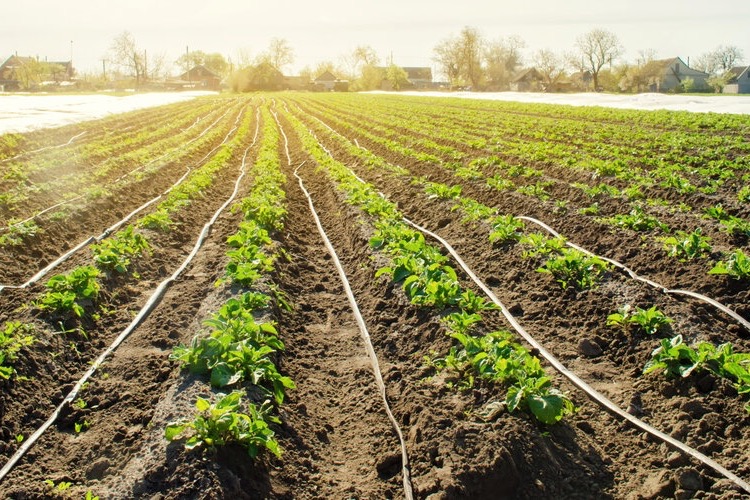
No sector uses more of the world’s water than farming, and none is more exposed to running short of it. The FAO’s 2025 AQUASTAT water data puts agriculture at around 72% of global freshwater withdrawals, and it records that renewable freshwater available per person has fallen by roughly 7% over the past decade. The pressure is not evenly spread: the FAO’s State of the World’s Land and Water Resources for Food and Agriculture 2025 estimates that about 1.2 billion people already farm in areas under severe water constraints, even as those same resources are asked to feed a population heading toward ten billion. And the water that matters most is concentrated: irrigated land is only about 22.5% of the world’s cropland but produces close to half of its crop value. The water under the most pressure is doing the most work. That is the backdrop for fertigation — delivering dissolved nutrients through the irrigation water itself — and it is why uniform fertigation has quietly become an engineering problem rather than an agronomic one.
Get the dose even across a field and you spend exactly the water and fertilizer the crop needs. Get it uneven and you waste both at one end of the field and starve the crop at the other. The decisive variable is not the recipe in the tank or the size of the pump. It is the flow at each outlet, and flow behaves in a way that defeats most intuition.
What fertigation is actually asking the system to do
Fertigation only works if every plant in a zone receives the same concentration of nutrient at the same rate. Concentration is set once, upstream, where soluble fertilizer is injected. But the dose delivered to the soil is concentration multiplied by flow: a branch that passes more water than its neighbour lays down more nutrient, even carrying identical solution. Uniform dosing therefore reduces to uniform flow.
This is well established in the irrigation literature. As work in Agricultural Water Management on dynamic pressure and emitter type shows, where outlets are not flow-regulated, those at higher pressure emit more water — and, in fertigation, more nutrient — than those downstream, and water and fertilizer distribution degrade together. Non-uniformity is not cosmetic: it is wasted abstraction from a stressed source, fertilizer that leaches or runs off, and uneven growth across the very land that delivers half the world’s crop value.
Why flow drifts across a field: Pressure-Coupled vs. Decoupled Flow
Here is the physics that makes uniformity hard. Flow through a fixed restriction — a plain orifice, a length of small-bore pipe, a hand-set valve — rises and falls with the pressure across it. Open the supply harder and the outlet passes more; let the supply sag and it passes less. We call this Pressure-Coupled Flow: the rate an outlet delivers is bolted to the pressure it happens to see, and nothing holds it to a target.
On a real field, the pressure an outlet sees is never the pressure at the pump. It decays along the main as friction eats head over distance, and it shifts again with elevation — every metre of rise costs roughly 10 kPa of static head. A branch near the pump, or downhill, sits at high pressure and over-delivers; a branch a kilometre away, or uphill, sits at low pressure and under-delivers. The injection point sent identical solution to both; the field received two different doses. The further and hillier the layout, the wider the spread — exactly the geometry of the large properties where fertigation earns its keep.
This is why “just use a bigger pump” does not fix uniformity. A bigger pump raises pressure everywhere, but unevenly — it widens the gap between the near outlet and the far one rather than closing it. The pump sets how much water and energy the system spends; it does not set how that water is shared. Sharing is a flow problem, solved at the outlet.
The Over-Circulation Penalty
Look only at the starved end of the field and the cost looks like lost yield. Look at the other end and there is a second, quieter cost. Wherever supply pressure runs high — near the pump, downhill, or whenever the rest of the system is drawing little — a pressure-coupled outlet pulls more water than the crop needs, and carries more dissolved nutrient with it.
We call this the Over-Circulation Penalty: the cumulative cost of every outlet drawing beyond its design rate simply because nothing holds the flow to target. In fertigation the penalty lands three times over. Scarce water is abstracted and applied where it cannot be used, on land the FAO’s irrigation-withdrawal data shows already drawing the largest share of any sector. Fertilizer that exceeds what the soil can hold leaches past the root zone or runs off, a loss to the grower and a load on the watershed. And the energy spent pumping that surplus is spent to make the problem worse, not better. The starved end and the flooded end are the same fault seen from two directions: flow that follows pressure instead of design.
Decoupling flow from pressure, at every outlet
The fix is mature, mechanical, and it sits exactly where the problem originates — at the outlet. It is a passive flow regulator installed in each branch line. The regulator holds the flow rate constant regardless of the pressure across it: a flexible rubber element deforms against a conical seat in proportion to the pressure differential, closing the flow path slightly as pressure rises and opening it as pressure falls, so the delivered rate stays at its pre-set value. When the supply runs high, the element narrows and the branch still passes its design flow. When the supply sags at the far corner of the field, the element opens and the branch still passes its design flow.
That is Decoupled Flow: the delivered rate no longer tracks the local pressure, so an outlet’s position on the line stops determining its dose. Every branch, near or far, downhill or up, lays down the same water and the same nutrient. The mechanism maps directly onto the two penalties above:
- Each branch draws its design flow and no more, so the Over-Circulation Penalty is removed at the outlet where it originates rather than corrected somewhere downstream after the water and fertilizer are already spent.
- The starved far end is brought up to design at the same time, because the regulator opens to hold its rate against low pressure — uniformity is restored from both ends at once.
- Because the regulation is built into the geometry rather than set by hand, it does not need re-balancing as the system ages, as lines are extended, or as a second crop changes the duty.
A clear boundary belongs here, because it is the honest one. A flow regulator does not treat water, recycle a return stream, meter or mix the fertilizer, or filter the supply. It does exactly one thing: it holds each branch to the flow it was specified for, regardless of pressure. In fertigation, that single thing is what turns a uniform solution into a uniform dose.
The proof point
The clearest way to see decoupling work is on a real distribution layout. On one fertigation system Bertfelt’s flow control serves, a 5,000-litre concentrate tank feeds a multistage centrifugal pump, which charges a 100 mm distribution main carrying on the order of 1,000 litres per minute. The branches that tap that main are 40 mm PVC lines, each fitted with a flow regulator pre-set to 102 litres per minute. Along the roughly one-kilometre run, friction pulls the main’s pressure down from about 600 kPa at the inlet to about 450 kPa at the far end — a 150 kPa spread between the first branch and the last.
On a pressure-coupled layout that 150 kPa spread would show up directly as a dosing gradient: the near branches over-delivering, the far branches falling short, the same nutrient solution laying down unevenly across the field. With a flow regulator on each branch, every line holds 102 litres per minute regardless of where it sits in that pressure decay. The dose per zone is uniform from the first branch to the last, and it stays uniform without anyone walking the field to re-trim valves. This is the application Bertfelt’s irrigation and farming page describes in plain terms — uniform fertiliser delivery in spite of available pressure, distance from supply, or elevation — and it is the same behaviour proven on the irrigation case study on long-distribution sites.
Frequently asked questions about fertigation flow control
Why does uniform fertigation depend on flow rather than pressure?
Because the dose delivered to the soil is the nutrient concentration multiplied by the flow at the outlet. The concentration is set once, upstream at the injection point, and is the same for every branch. So the only thing that makes one branch lay down more nutrient than another is its flow. If each branch is held to the same design flow, each lays down the same dose; if flows differ, doses differ — no matter how carefully the solution was mixed.
Won’t a pressure-reducing valve give me uniform dosing?
No — it solves a different problem. A pressure-reducing valve holds downstream pressure to a set value, but flow through the outlets still varies with the restriction at each one and with their position on the line. A flow regulator holds flow constant regardless of the pressure differential across it. When the goal is an even dose across distance and elevation, flow is the variable to fix, not pressure.
Where should the regulator be installed?
In each branch line whose flow you want fixed, on the supply side of the outlets it feeds. Threaded variants suit individual branch lines on a per-zone basis; a larger Wafer variant can sit on a main feeding a bank of branches where one device governs the flow into the group. The principle is to place the regulator between the variable pressure of the main and the outlet whose dose you want held constant.
Does this need power, sensors, or a controller?
No. The regulator is passive and self-contained — no electricity, no signal, no control integration. It is specified for the design flow and installed in the line; regulation happens mechanically as pressure varies. That makes it a retrofit onto existing fertigation and irrigation mains rather than a re-design of the pump house or the control system.
What pressure range does it work across?
The rubber element needs a minimum pressure differential — roughly 1.4 bar on the standard compound — to deform into its regulating position; below that it passes flow without regulating, so the mechanism is paused, not failed. The standard compound regulates up to 10 bar, and alternate compounds extend the range to 20 bar. For fertigation lines that run at low differential pressure — the far or uphill end of a long main, where much of the head has already been spent — there is also a dedicated low-pressure solution with a differential-pressure range of 0.45 to 5 bar, so each branch can still be held to its design flow where the standard 1.4 bar minimum would not be met. Body materials and control-rubber compounds are selected for the water chemistry and the dissolved fertilizers in the line.
Is this a single-zone measure or a whole-field one?
Both, and they add up. One regulated branch delivers one zone’s correct dose. The field-scale effect is the sum of those corrections across every branch on the main — the near zones no longer over-applying, the far zones no longer starved. On land that the FAO shows already drawing the largest share of a stressed water supply, the additive saving in water and fertilizer is the part of the problem an engineer can specify directly.
Agriculture’s claim on the world’s water is not going to shrink, and no flow regulator will resolve water scarcity on its own. But the FAO’s data is clear that farming is where most freshwater is spent, that the water is increasingly scarce, and that the irrigated fraction does most of the feeding — which makes every avoidable litre and leached gram of fertilizer worth holding onto. Uniform fertigation is the lever, and it is a flow problem before it is anything else. A passive flow regulator on each branch — Threaded for individual zones, Wafer for a main feeding a bank — decouples flow from pressure so the dose the tank prepared is the dose the field receives, from the first branch to the last.
Contact our experts!
Our team of experts is here to provide you with the knowledge and support you need. Whether you have questions about our products, need assistance choosing the right solutions, or want to discuss your unique requirements, our specialists are ready to help. With years of experience and a deep understanding of industry standards, we’re committed to offering you reliable guidance every step of the way. Don’t hesitate to get in touch – we look forward to assisting you!